Ink Explained: Kraken's Layer 2 and What It Means for the Future of DeFi
Kraken has launched Ink, its own Layer 2 blockchain designed to bridge the gap between holding crypto on an exchange and actively using it in DeFi. Following Coinbase's success with Base, Ink aims to funnel Kraken's 10 million-plus users into on-chain finance with minimal friction and a confirmed airdrop.
→Ink is Kraken's live Layer 2 blockchain that enables users to move from exchange accounts to on-chain DeFi activities like lending, trading, and earning with a single click.
→Coinbase's Base chain grew to over $5 billion in total value locked within 18 months, demonstrating the massive potential for exchange-built blockchains that Kraken aims to replicate.
→The biggest unsolved problem in crypto — the gap between owning assets and actually using them — is driving major exchanges to build their own blockchain infrastructure.
→Ink launched on December 18, 2024, and has a confirmed airdrop attached, creating an early incentive for users to engage with the chain.
$0 → $5.34B
Base TVL Growth
~$8.5M
Ink TVL Today
10M+
Kraken Users
If you buy crypto on Kraken, something fundamental just changed. For the first time, you can go from holding coins on an exchange to lending, trading, and earning on-chain — with one click, no manual bridging, no wallet gymnastics — all on a blockchain Kraken built themselves. It's called Ink, it launched three months ago, and there's a confirmed airdrop attached.
This isn't theoretical. Ink is live. People are using it. And if you understand what happened when Coinbase built its own blockchain — a chain called Base that grew from zero to over $5 billion in total value — you'll understand why Ink matters.
Let's break it down from the beginning.
01
Why a Crypto Exchange Is Building a Blockchain
Here's the quiet shift happening in crypto that most people haven't noticed: the biggest exchanges are no longer content being places where you buy and sell. They're becoming platforms where you use crypto.
Think about it. You buy ETH on Kraken. Then what? It sits there. Maybe you trade it. Maybe you withdraw it to a wallet and try to figure out DeFi on Ethereum mainnet — where a single swap can cost $5 to $50 in gas fees, transactions take 12 seconds, and the interface feels like it was designed for engineers, not humans.
That gap — between owning crypto and actually using it — is the biggest unsolved problem in the industry. And exchanges are realizing the answer is to build the infrastructure themselves.
Coinbase figured this out first. In July 2023, they launched Base, their own Layer 2 blockchain. Within 18 months, Base grew from nothing to a peak total value locked (TVL) of $5.34 billion. It became one of the most active blockchains in existence, with millions of users flowing from their Coinbase accounts directly into DeFi.
Kraken watched this happen. And on December 18, 2024, they launched Ink — their answer to Base. A Layer 2 blockchain built to funnel Kraken's 10 million-plus users from exchange accounts into on-chain finance, with the lowest possible friction.
The thesis is simple: if your users are going to use DeFi anyway, build the DeFi they use.
02
What a Layer 2 Actually Is (No Jargon, No Hand-Waving)
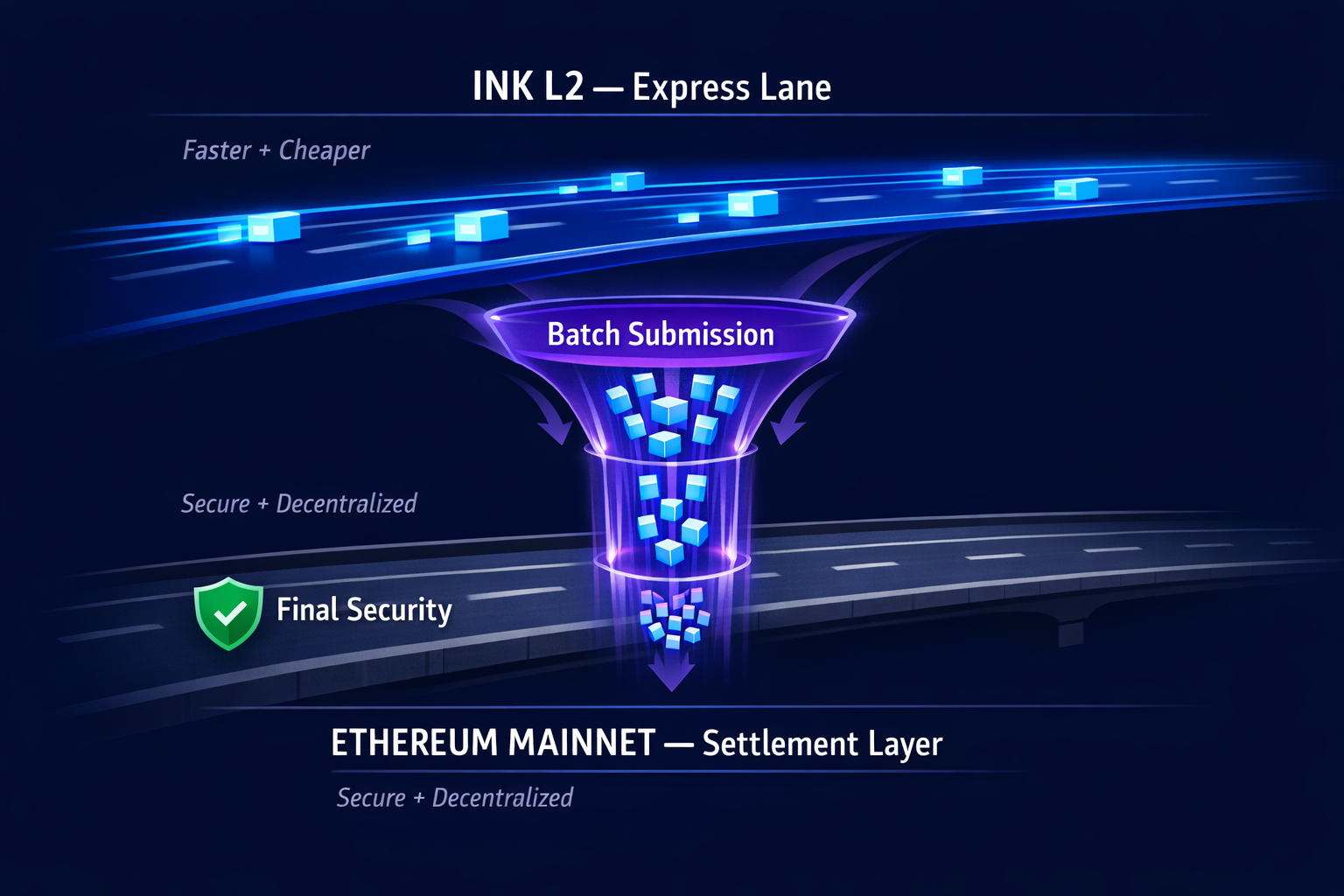
Anatomy diagram showing how transactions flow from the Ink L2 express lane down to Ethereum mainnet
Anatomy diagram showing how transactions flow from the Ink L2 express lane down to Ethereum mainnet
If you've never encountered the term Layer 2 before, here's the plain-English version.
Ethereum is the most trusted blockchain in the world, but it's slow and expensive. Think of it as a congested highway — secure, well-maintained, but jammed with traffic. A Layer 2 is an express lane built on top of that highway. It processes transactions faster and cheaper, then periodically merges back onto the main highway to settle up and inherit its security.
Ink is specifically an Optimistic Rollup — a type of Layer 2 that assumes all transactions are valid unless someone proves otherwise. Think of it as "innocent until proven guilty" for blockchain transactions. This is the same technology used by Base, OP Mainnet, and a dozen other major chains.
Three things to know about Ink's technical identity:
›Block time: 1 second (targeting sub-second). That means transactions confirm almost instantly. For comparison, Ethereum takes ~12 seconds and even Base takes 2 seconds.
›Gas fees: Pennies. A swap that costs $5–$50 on Ethereum costs fractions of a cent on Ink.
›EVM-compatible. This means every Ethereum wallet you already use — MetaMask, Rabby, Coinbase Wallet — works on Ink without modification. No new software. No learning curve.
For a Kraken user accustomed to instant trades, Ink makes DeFi feel like using an exchange: fast, cheap, and familiar. The difference is that you control your assets, not a company.
Ethereum Mainnet
Ink (Layer 2)
✓12-second block times
✓1-second block times
✓$5–$50+ gas fees
✓Pennies per transaction
✓Battle-tested security
✓Inherits Ethereum security
03
The Optimism Superchain: Ink Isn't an Island
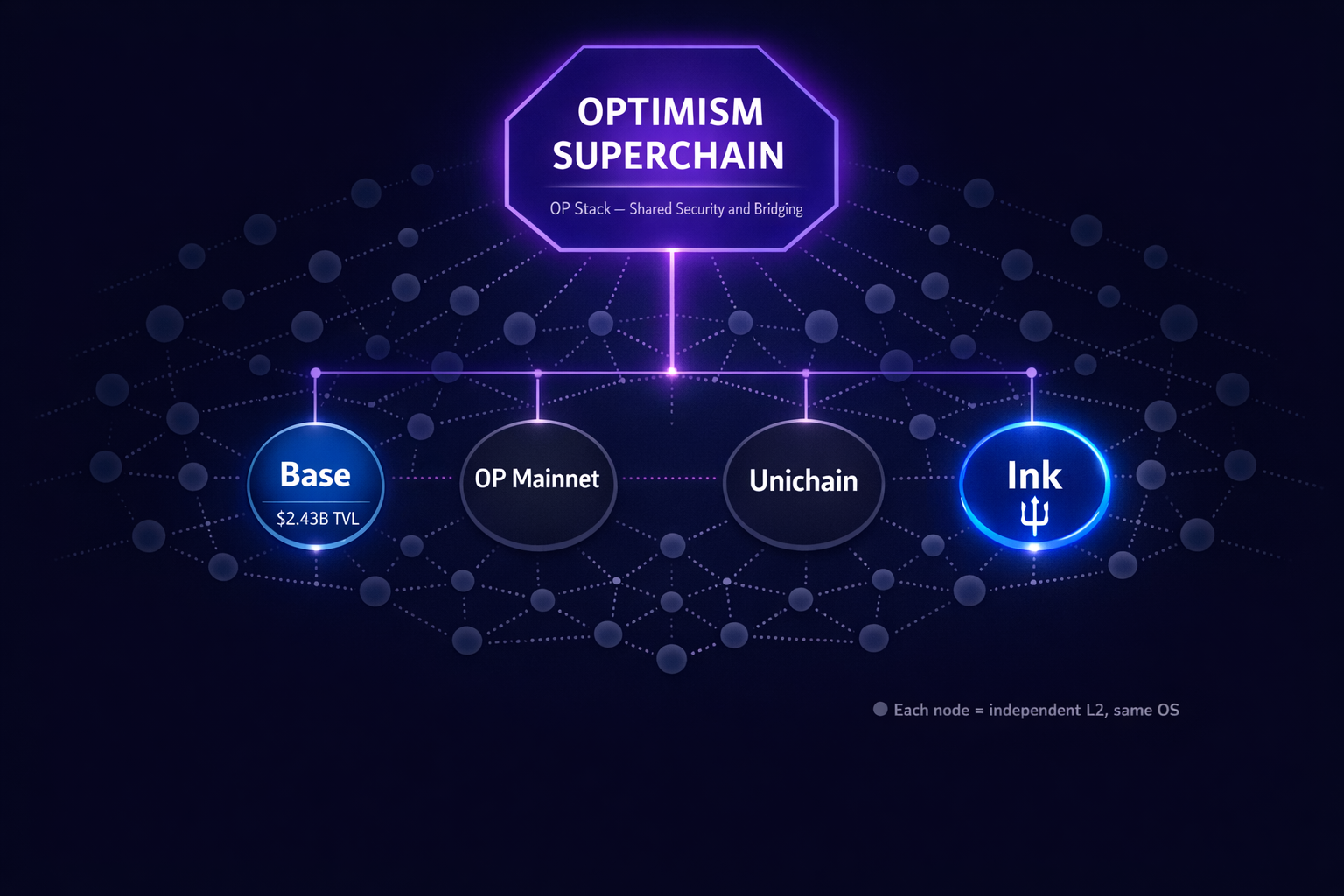
Hierarchy map showing Ink as one interconnected node among 34 OP Stack chains in the Optimism Superc
Hierarchy map showing Ink as one interconnected node among 34+ OP Stack chains in the Optimism Super
Here's where the picture gets bigger. Ink isn't a standalone blockchain floating in isolation. It's part of the Optimism Superchain — a network of 34+ Layer 2 blockchains all built on the same technology (the OP Stack), sharing security, bridging infrastructure, and governance.
The Superchain's members include some of the most important chains in crypto:
Think of the Superchain like Android. Each phone (L2) is different — different brand, different features, different audience — but they all run the same operating system and can communicate with each other.
This matters for one critical reason: SuperchainERC20, a new token standard that lets assets move between any Superchain L2 natively. No third-party bridges. No Wormhole. No LayerZero. If you have a token on Ink, you can move it to Base or OP Mainnet directly, with no bridge-hack risk. It's like a universal plug adapter for crypto assets.
Ink also received a 25 million OP token grant from Optimism — a significant endorsement and funding commitment from the Superchain's governing body. For context, Base received 118 million OP, reflecting Coinbase's larger scale, but 25 million is substantial for a newly launched chain.
→
Ink Is Connected, Not Isolated
As a Superchain member, Ink has native interoperability with 34+ other L2s. Your assets aren't trapped — you can move between chains using SuperchainERC20 or bridge via Across Protocol in ~2 seconds.
04
The Security Detail Most People Miss
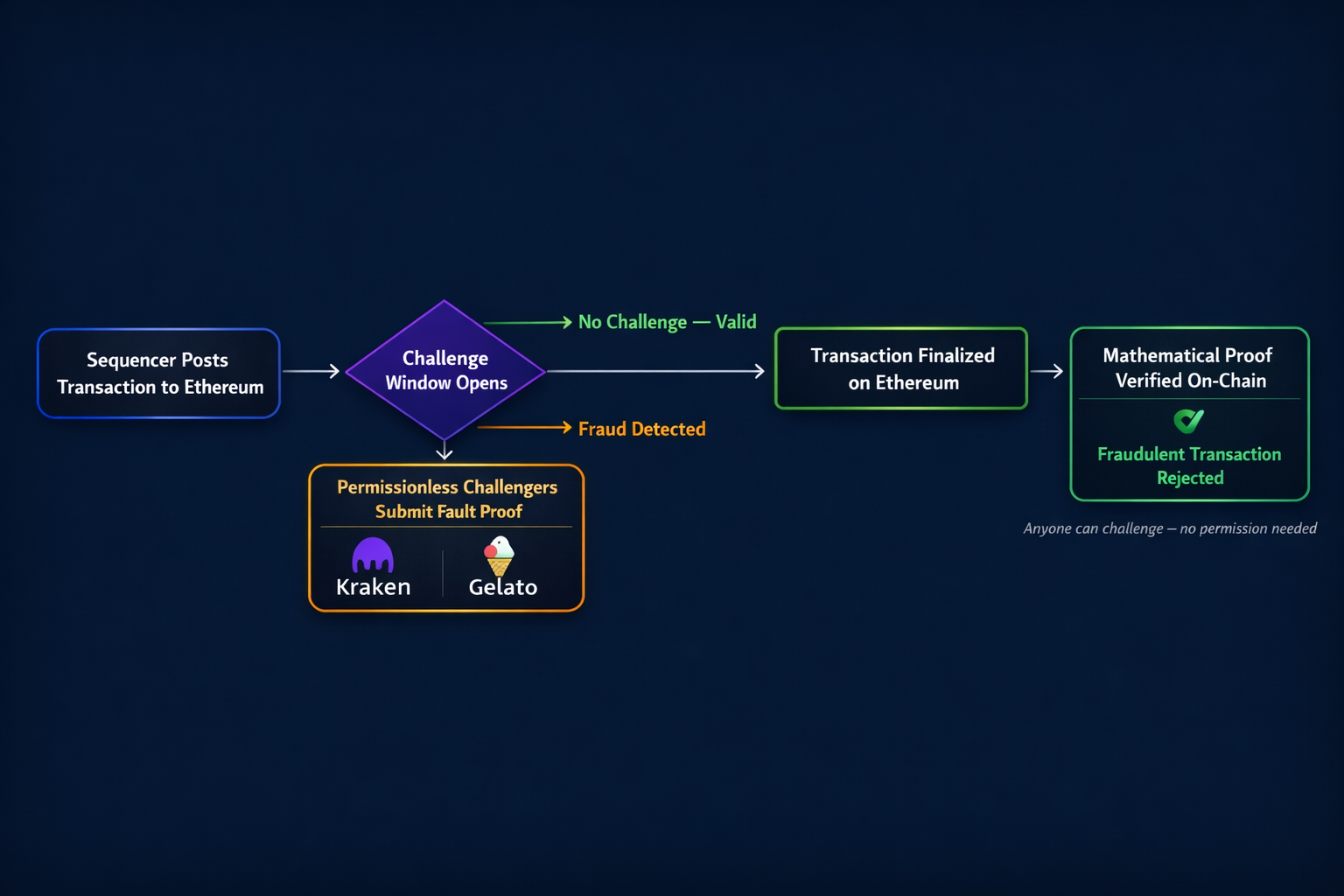
Flow diagram illustrating the permissionless fault proof challenge process where multiple challenger
Flow diagram illustrating the permissionless fault proof challenge process where multiple challenger
This is technical, but it matters — especially if you're entrusting real money to a new chain.
Most Layer 2s launch with a centralized sequencer and no way for users to challenge invalid transactions. You're essentially trusting the operator. If they post a fraudulent transaction to Ethereum, there's no mechanism to dispute it. This is a known tradeoff that most L2s accept early on and plan to fix later.
Ink took a different approach.
In January 2025 — just weeks after mainnet launch — Ink implemented permissionless fault proofs with multiple challengers (Kraken and Gelato), making it the first Superchain with this security model. In plain English: if someone tries to post a fraudulent transaction, anyone can challenge it and mathematically prove it's wrong. You don't have to trust Kraken alone. Even one honest challenger protects everyone.
For comparison, Base launched in July 2023 and didn't add fault proofs until October 2024 — over 14 months later. Ink had them within weeks.
Think of it like this: most new L2s launch with zero independent auditors checking the books. Ink launched with multiple, and the system is designed so anyone can become an auditor. For DeFi users who care about the "don't trust, verify" ethos, this is a meaningful differentiator.
05
The Base Comparison: What History Tells Us
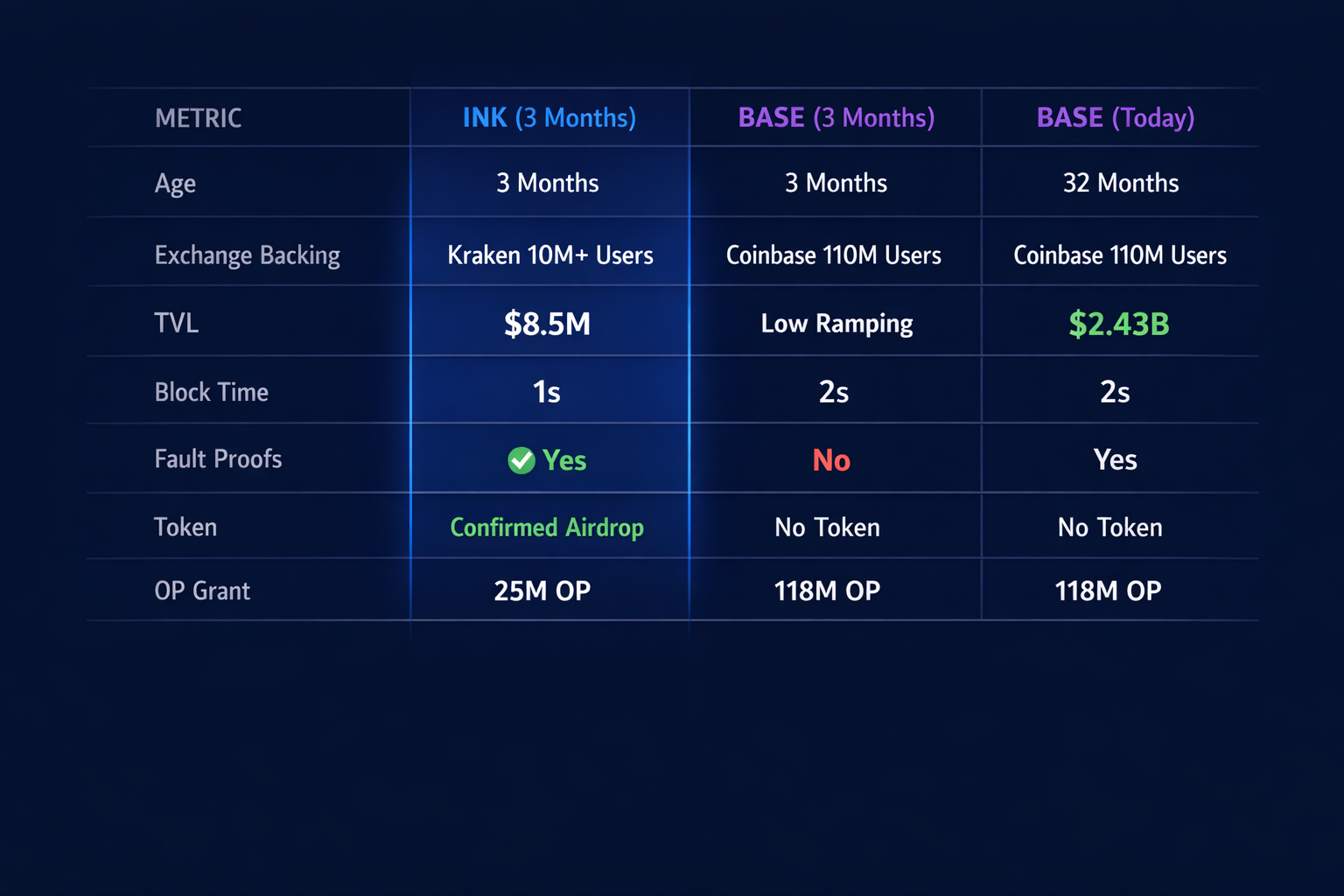
Sidebyside comparison table of Ink versus Base across key metrics like TVL, block time, fault proofs
Side-by-side comparison table of Ink versus Base across key metrics like TVL, block time, fault proo
This is the comparison that matters most. Base is the proof of concept for the entire "exchange builds a blockchain" thesis. What happened with Base is the best predictor of what could happen with Ink — and where the limits might be.
Here's the honest side-by-side:
| Metric | Ink (March 2026) | Base (at 3 months) | Base (today) |
| Fault proofs | Yes, multiple challengers | No (added Oct 2024) | Yes |
| Token | Confirmed airdrop (Q3 2026 expected) | No token | No confirmed token |
| OP Grant | 25M OP | 118M OP | 118M OP |
Let's be honest about what this comparison tells us — and what it doesn't.
Where Ink has an advantage: A confirmed token airdrop is a powerful incentive that Base has never offered. Faster blocks. Better security from day one. These are real differentiators.
Where Base has the edge: Coinbase has 11 times more users than Kraken. A 4.7x larger OP grant. A 14-month head start. Ink won't replicate Base's exact numbers — the parent exchange is simply smaller.
What the comparison actually tells us: Base proved the model works. An exchange-backed L2, with a built-in user funnel, can grow from nothing to billions. Ink is running the same playbook with different advantages (speed, fault proofs, a token catalyst) and different constraints (smaller user base). The trajectory is the signal, not the snapshot.
$8.5 million in TVL looks small — and it is. But Base's was tiny at three months too. TVL is a lagging indicator for new chains. The question isn't "how big is Ink today?" It's "what does the growth curve look like?"
By the numbers
$0 → $5.34B
Base TVL Growth
~$8.5M
Ink TVL Today
10M+
Kraken Users
06
What You Can Actually Do on Ink Today
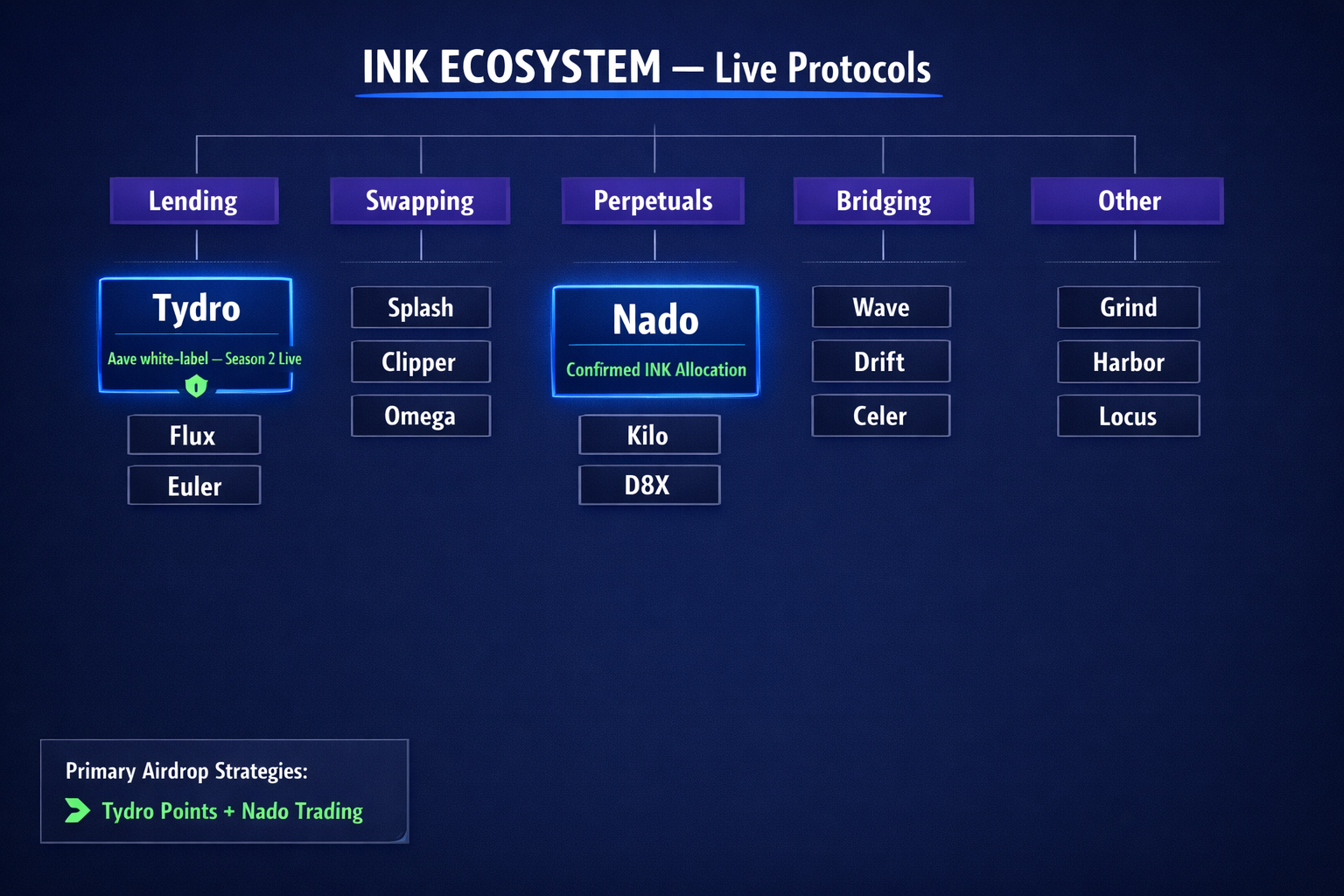
Hierarchy map of the live Ink ecosystem organized by DeFi primitives including lending, swapping, pe
Hierarchy map of the live Ink ecosystem organized by DeFi primitives including lending, swapping, pe
For a three-month-old chain, Ink already has every major DeFi primitive — lending, swapping, perpetual futures, bridging, NFTs, and domain registration — live and functional.
Tydro is the protocol to understand. It's a lending platform built as an Aave white-label instance — meaning it runs on Aave's battle-tested smart contract codebase, adapted for Ink. You supply assets (like ETH, USDC, or others), and you earn Tydro Points. These points are the primary mechanism for qualifying for the INK airdrop. Tydro Season 1's snapshot is already done. Season 2 is live right now.
Nado is the second most important protocol for airdrop positioning. It's a perpetual futures DEX, and the team has explicitly confirmed that Nado users will receive INK token allocation. If you trade perps, this is where to do it on Ink.
Velodrome and SuperSwap provide decentralized exchange functionality — swap tokens, provide liquidity, participate in the ecosystem's trading activity.
The rest — ZNS for .ink domains, Sweep for NFT minting, OnChainGM for deploying smart contracts, and Guild for community achievements — are lower-capital actions that signal ecosystem participation. They cost little but may contribute to airdrop qualification.
Velodrome — DEX and liquidity marketplace (native Superchain)
✓
SuperSwap — Decentralized exchange built for Ink
✓
Nado — Perpetual futures trading. INK allocation confirmed.
✓
Across Protocol — Day-1 bridge partner. 2-second L2-to-L2 transfers.
✓
ZNS — .ink domain name registration
✓
Sweep — Ink Pass NFT minting
07
How to Get Onto Ink
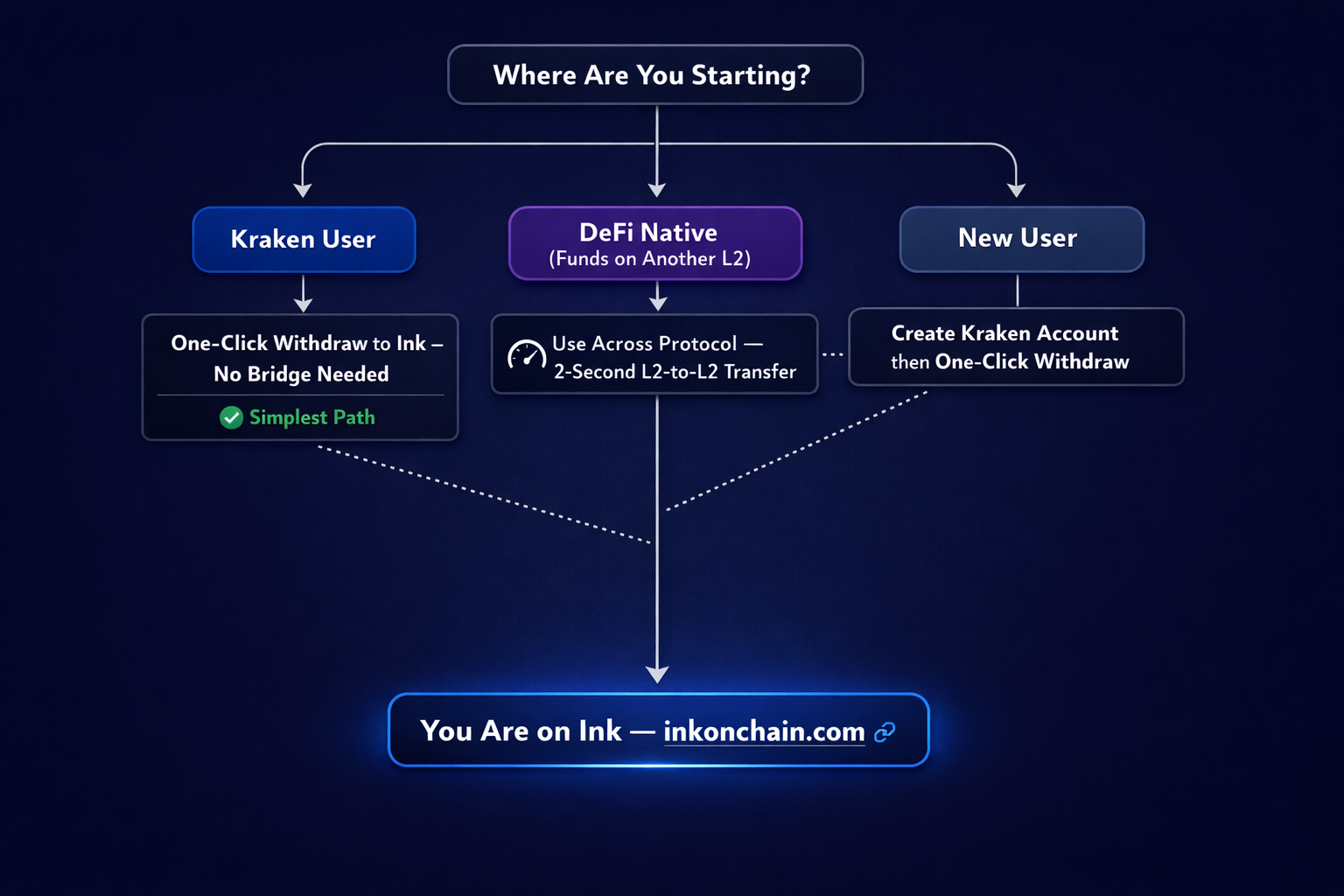
Decision tree flow diagram guiding users from three starting points Kraken user, DeFi native, new us
Decision tree flow diagram guiding users from three starting points (Kraken user, DeFi native, new u
Three paths, from simplest to most flexible:
The one-click Kraken integration is the entire thesis in action. It eliminates the single biggest barrier to DeFi adoption: the bridge. If you've ever tried to bridge assets between chains manually — copying addresses, choosing networks, waiting, worrying — you know why this matters. Kraken users skip all of that.
If you're already in the DeFi world and want to move funds from another L2, Across Protocol is the best option. It was Ink's day-1 bridge partner, and 2-second L2-to-L2 transfers make it functionally instant.
Native integration means one click from your exchange account to Ink. No manual bridging. No wallet setup. This is the killer feature.
2
Optimism Superbridge (Free)
The canonical Superchain bridge at app.optimism.io/bridge. Sends assets from Ethereum mainnet or other Superchain L2s to Ink. You only pay gas.
3
Across Protocol (Fast)
2-second bridging between L2s. Best if you're already on Base, Arbitrum, or another L2. Small fee applies.
08
The Confirmed INK Airdrop: What We Know and What We Don't
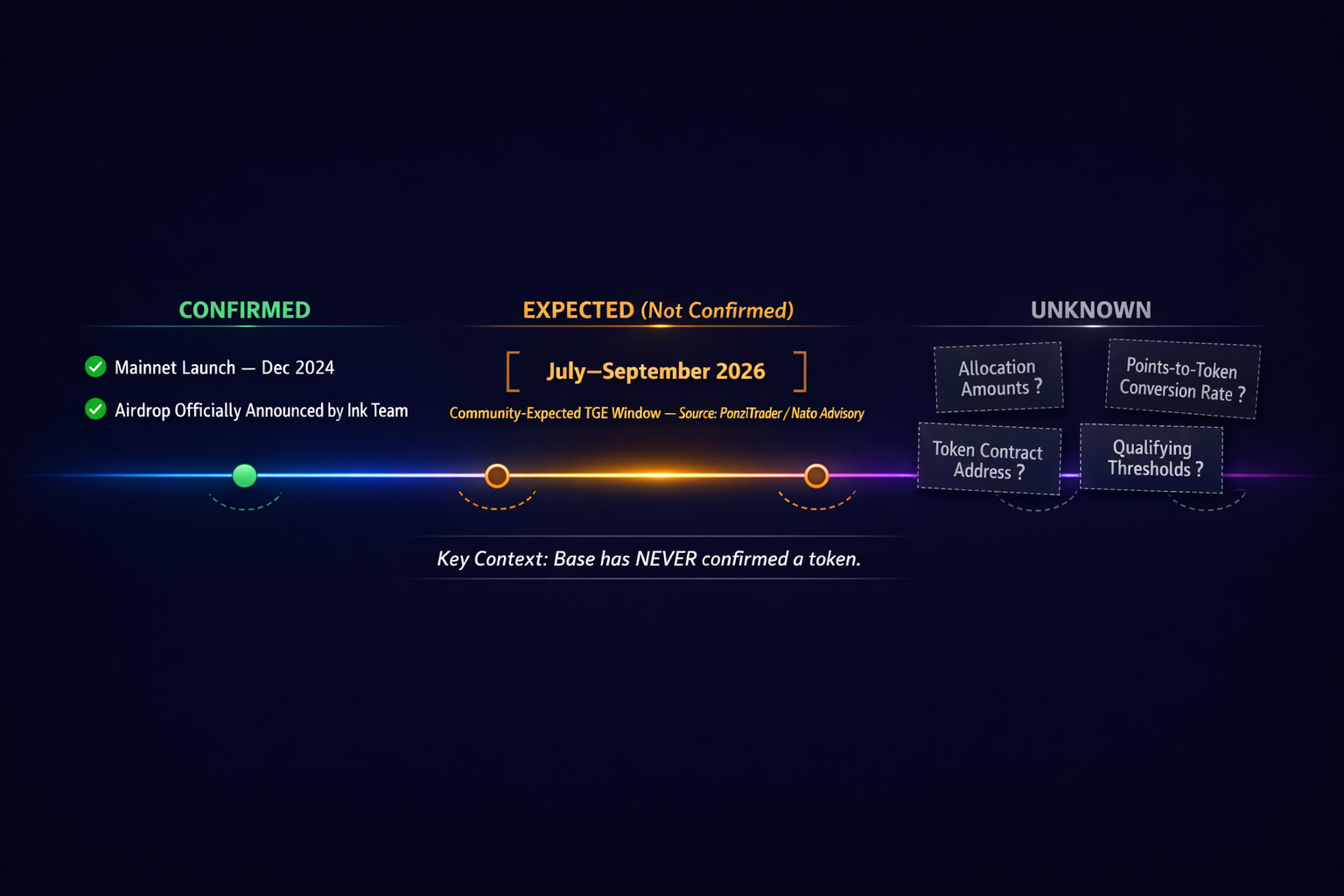
Structured timeline distinguishing confirmed facts from community expectations and unknowns leading
Structured timeline distinguishing confirmed facts from community expectations and unknowns leading
Let's be precise about this, because precision matters when money is involved.
What is confirmed: Ink has officially announced an INK token airdrop. This is not a rumor. It's not speculation. It's stated by the team.
What is expected but not confirmed: The community expectation, based on reporting from PonziTrader (who advises the Nado protocol), is that the Token Generation Event (TGE) will occur between July and September 2026. This is approximately 4-6 months from now. However, no official date has been announced by the Ink team.
What is unknown: Allocation amounts. Points-to-token conversion rate for Tydro. Token contract address. Specific qualifying thresholds.
Now, here's why this matters in context: Base has never confirmed a token. Coinbase's L2 grew to $5.34 billion in TVL without any token incentive. Ink is offering what Base didn't — a direct financial incentive for early adoption. Whether that makes Ink's growth trajectory faster, slower, or differently shaped than Base's is an open question. But the catalyst exists.
The Six Airdrop Qualification Paths
Based on confirmed information and strongly implied signals, these are the ways to position yourself:
1. Tydro LP (Primary path): Supply assets on Tydro. Earn Tydro Points. Season 2 is live now. This is the single most important action you can take. → tydro.com
2. Nado trading: Trade perpetual futures on Nado. INK allocation has been explicitly confirmed for Nado users. Volume and activity are tracked.
3. General ecosystem activity: Bridge assets. Swap on Velodrome or SuperSwap. Maintain a transaction count across multiple protocols. Breadth matters — touching many protocols signals genuine usage.
4. NFT and domain registration: Mint the Ink Pass NFT via Sweep. Register a .ink domain via ZNS. These are low-cost, high-signal actions.
5. Developer path: Deploy a smart contract via OnChainGM. This is one-click and requires no coding — it's designed for accessibility, not gatekeeping.
6. Community participation: Join and engage in Discord (100,000+ members). Complete Guild achievements. Send GMs on OnChainGM.
The key insight: the expected TGE is 4-6 months away. That's not a sprint — it's time to build a genuine usage history across the ecosystem. Steady, diversified activity over months is almost always valued more by airdrop committees than a single large action the day before a snapshot.
→
The Meta-Strategy
Airdrops almost always reward breadth AND depth. Don't just supply assets on Tydro — also swap on Velodrome, trade on Nado, mint an NFT, and register a domain. Be a real user across multiple protocols, not a single-action bot. Consistency over time matters more than a single large deposit.
09
Honest Risk Assessment
This is the section that separates useful analysis from hype. If you're considering putting time or money into Ink's ecosystem, you need to understand these risks clearly.
Smart contract risk. Every protocol on Ink is relatively new. Tydro runs on Aave's battle-tested codebase, which reduces — but does not eliminate — risk. The deployment itself is new, and any new deployment can have configuration errors or unforeseen interactions.
Liquidation risk. If you use borrow loops on Tydro — depositing an asset, borrowing against it, then depositing the borrowed asset again to amplify your points — you amplify both potential rewards and potential losses. If the value of your collateral drops sharply, the protocol will automatically sell your position (liquidation). This can happen quickly in volatile markets. Don't loop with money you can't afford to lose.
Airdrop uncertainty. The airdrop is confirmed, but no allocation amounts have been disclosed. The points-to-token conversion rate for Tydro is unknown. There's no guarantee that your specific activity will qualify for a meaningful allocation. "Confirmed airdrop" does not mean "confirmed profit."
Market risk. A token launching during unfavorable market conditions may underperform regardless of fundamentals. The timing of TGE relative to broader market cycles matters, and that's entirely outside anyone's control.
Liquidity risk. $8.5 million in TVL is thin. Large trades or withdrawals can cause significant slippage. This is a natural characteristic of early-stage ecosystems, but it means your experience with large positions will differ from what you'd encounter on more established chains.
Regulatory risk. Exchange-backed L2s could face regulatory scrutiny. Kraken is a US-regulated entity with compliance infrastructure, which mitigates this to some degree, but the regulatory landscape for L2 tokens remains uncertain.
Everything in this article is educational content, not financial advice. Participation in any DeFi protocol carries risk, including the risk of total loss of deposited funds.
10
What "Early" Actually Means
The word "early" gets thrown around a lot in crypto. Let's define it with actual numbers.
Ink has been live for approximately three months. Its TVL is ~$8.5 million. Its Discord has over 100,000 members. Its ecosystem has a handful of live protocols. It processes 2.4 million gas per second, representing 4.8% of all Superchain activity — a non-trivial share for a chain that's barely out of the gate.
If the TGE happens in July–September 2026 as expected, that's 4-6 months of accumulation time remaining. Here's why the timing window matters:
Lower TVL = larger relative share. When you supply assets to a lending protocol with $8.5 million in TVL, your proportional share of the pool — and likely of any rewards — is larger than it would be in a pool with billions.
Fewer users = less competition. Airdrops distribute a fixed supply of tokens across participants. Fewer participants means larger individual allocations, all else being equal.
Protocols are actively incentivizing. Tydro is running points seasons. Nado has confirmed allocations. The ecosystem needs users and liquidity right now, which means the incentive structures are designed to attract exactly the kind of early participation you'd be providing.
The other side of "early": smart contracts are less battle-tested. Liquidity is thinner. If the token underperforms at launch, the time spent farming yields less than expected. Early carries risk alongside opportunity — that's what makes it early.
11
The Bigger Picture: Exchanges Becoming Platforms
Zoom out for a moment.
What's happening with Ink isn't just about Kraken or this specific chain. It's the beginning of a structural shift in how the crypto industry works. Exchanges are evolving from brokerages — places you buy and sell — into financial platforms that encompass everything from custody to on-chain lending to governance.
Coinbase showed the path with Base. Kraken is following with Ink. It would be surprising if other major exchanges don't announce similar L2 initiatives in the coming months and years.
The Superchain itself is growing toward becoming the connective tissue of this new infrastructure. With 34+ chains, native interoperability via SuperchainERC20, and the backing of the largest exchanges and protocols in crypto, it's building the closest thing to a unified DeFi experience that currently exists.
For Kraken users specifically, Ink represents the simplest on-ramp to DeFi available today. One click from your exchange account to a blockchain where you can lend on Tydro, trade perpetuals on Nado, swap on Velodrome, mint NFTs, and register a domain — all with 1-second transactions and negligible fees.
And for the broader crypto ecosystem, Ink is a data point in the most important experiment running right now: whether exchange-backed L2s are the bridge that finally brings mainstream users on-chain.
Base answered "yes" to the tune of $5.34 billion. Ink is three months into answering the same question — with a confirmed token incentive that Base never offered.
12
What to Do Next
If you've read this far, you understand what Ink is, why it exists, and what the opportunity looks like. Here's a clear action path:
1. Bridge to Ink. If you're a Kraken user, use the native one-click integration. Otherwise, use the Optimism Superbridge or Across Protocol. Start at inkonchain.com.
2. Supply assets on Tydro. This is the primary airdrop qualification mechanism. Season 2 is live. Go to tydro.com, supply what you're comfortable with, and start earning Tydro Points. Do not over-leverage. Do not use borrow loops unless you fully understand liquidation risk.
3. Diversify across the ecosystem. Swap on Velodrome or SuperSwap. Trade on Nado if you use perpetuals. Mint the Ink Pass NFT. Register a .ink domain. Deploy a contract on OnChainGM. Breadth of activity matters.
4. Be consistent. The expected TGE is months away. Steady activity over weeks and months signals genuine usage. Don't try to game it with a single burst of transactions.
5. Stay informed. Follow @inkonchain on Twitter. Join the Discord. Read the docs. Airdrop details — allocations, snapshot dates, TGE timing — will be announced through official channels.
And above all: only participate with funds you can afford to lose. Smart contract risk is real. Market risk is real. Opportunity and risk are two sides of the same coin — always.
Ink is three months old. In crypto, three months is nothing and everything. What you do in the next few months could matter. Whether it will is an honest question — one that only time, execution, and market conditions will answer.