⚠ Smart contract risk warning before you deploy capital: Ink's protocols are young — most have been live for months, not years. Lower TVL chains carry elevated smart contract risk because: (1) protocols have had less time and less adversarial exposure to surface bugs; (2) thin liquidity means exploits can drain a larger percentage of total protocol funds; and (3) audit coverage may be incomplete or limited to initial deployment without covering subsequent upgrades. Before committing capital to any protocol below, check its audit status (look for reports from firms like Trail of Bits, OpenZeppelin, Spearbit, or Cyfrin), verify whether a bug bounty programme exists, and never commit more than you can afford to lose entirely. This is especially important for the £1,000+ commitment levels discussed in the airdrop strategy section.
Tydro is the protocol most likely to matter for airdrop qualification, and understanding its mechanics is worth the detail. Tydro is a lending protocol on Ink that uses an Aave-style architecture — verify on Tydro's documentation whether it is a direct fork of Aave V3 contracts or a custom implementation inspired by Aave's design, as this distinction matters for the level of confidence you place in its battle-testedness. If it is a direct fork, it inherits a well-tested codebase, but deployments on new chains can introduce unique risks (different compiler configurations, different gas economics, different interaction patterns with L2-specific opcodes). If it is a custom implementation, treat it as a newer, less battle-tested protocol regardless of its similarity to Aave's interface. Check whether Tydro has published third-party audit reports and whether a bug bounty programme is active before depositing.
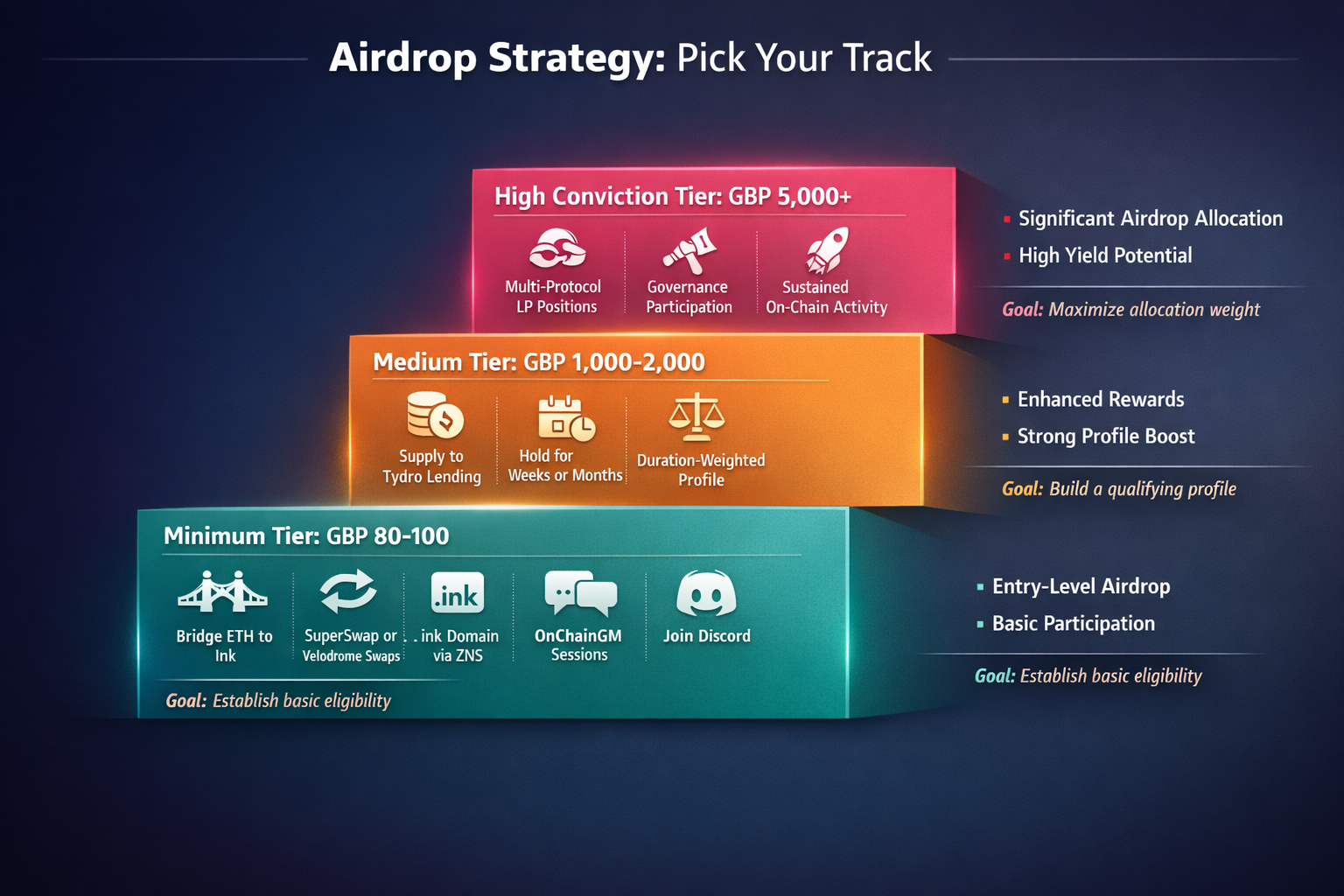
You supply assets (ETH, stablecoins) into lending pools, earn variable interest from borrowers, and accumulate Tydro points that track toward the INK airdrop. Season 1's snapshot is already complete, meaning if you didn't participate, that allocation window has closed. Season 2 is live now. A critical nuance: Tydro points may weight duration of supply, not just size — this is unverified speculation based on community observation, not confirmed by the team. If true, depositing $2,000 for three months would outperform depositing $6,000 for one month, because sustained activity signals genuine usage to sybil filters. Do not treat this as confirmed strategy — the actual point weighting formula has not been disclosed. Before committing capital, estimate your potential returns using a staking and yield calculator to compare Ink lending rates against other opportunities across the Superchain.
Nado is the second most impactful protocol for airdrop qualification, and it's explicitly confirmed: INK token allocations will go to Nado traders. It's a perpetual futures DEX — meaning you can trade long or short positions on crypto assets with leverage, without expiry dates. Volume and trading activity are being tracked. Key parameters to verify on Nado's documentation before trading: maximum leverage offered, which oracle provider supplies price feeds (Pyth, Chainlink, or another), funding rate structure, and liquidation thresholds. On a chain with limited TVL, liquidity depth is a critical concern — thin liquidity pools mean larger positions face significant slippage, and liquidation cascades can be amplified when there isn't sufficient depth to absorb forced selling. If you're comfortable with leveraged trading and understand these liquidation mechanics, Nado is a direct, confirmed path to INK allocation. If you've never traded perps, this is not the place to learn — the risk of liquidation on a low-liquidity chain is meaningfully higher than on established venues.
Velodrome brings a proven model from OP Mainnet to Ink. It's a DEX and liquidity marketplace — meaning protocols can direct token emissions to specific trading pairs to incentivise liquidity. Providing liquidity on Velodrome earns you trading fees plus any incentivised emissions. The team's track record on OP Mainnet (where Velodrome is the dominant DEX by TVL) provides credibility that most new-chain DEXs lack.
Exactly Protocol deserves separate consideration from Tydro despite both being lending protocols. Exactly offers fixed-rate lending alongside variable rates — meaning you can lock in a known interest rate for a defined period. Sophisticated users will split their lending capital: Tydro for airdrop point accumulation (where variable rates and point systems align), Exactly for actual yield predictability. Most guides lump all lending together as interchangeable. It isn't.
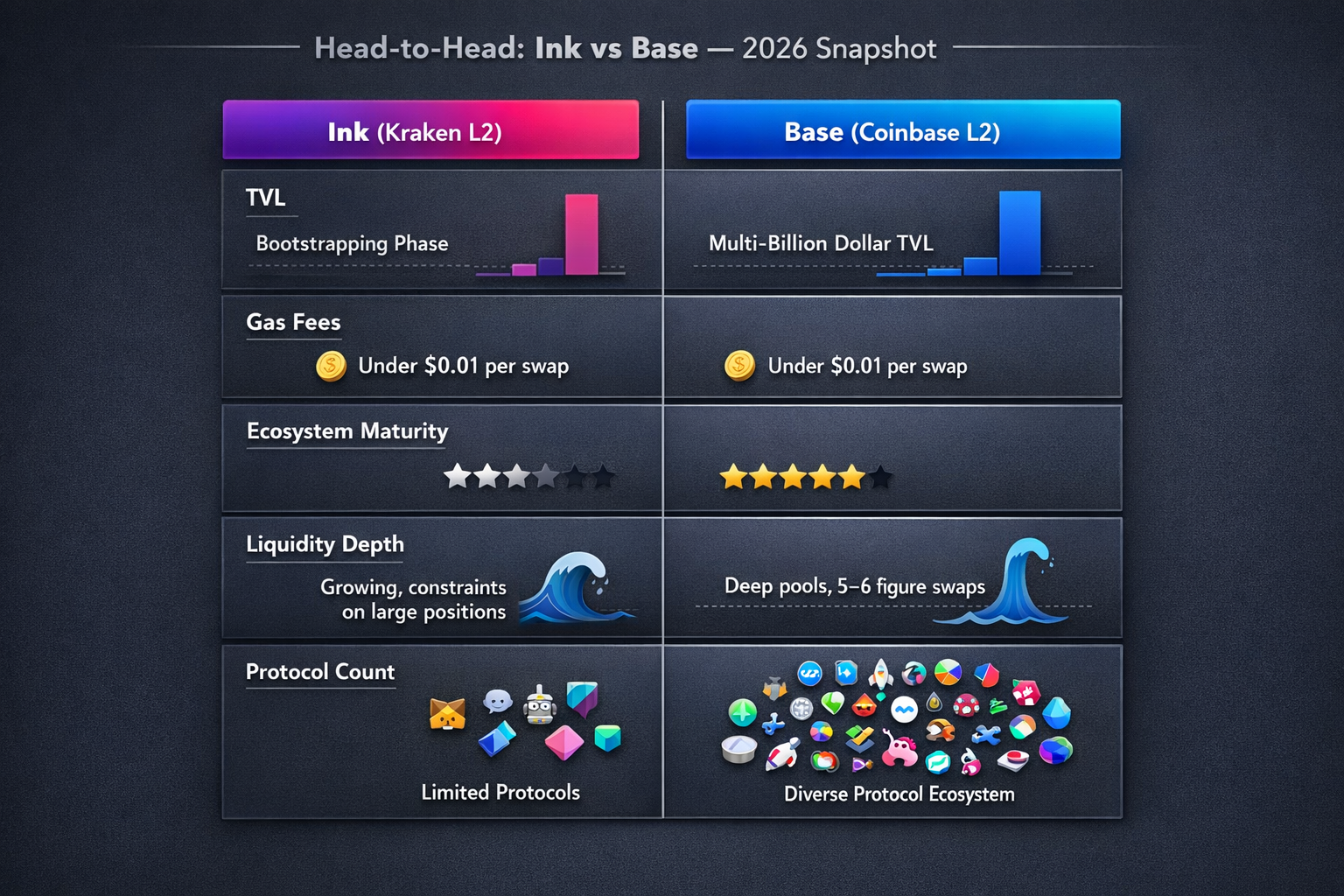
⚠ Common mistake: Treating Ink's low TVL as "nothing to do." The ecosystem covers lending (Tydro, Exactly), spot trading (Velodrome, SuperSwap), leveraged trading (Nado), bridging (Across), and identity (ZNS). The low TVL actually creates higher yield opportunities for early liquidity providers — fewer participants competing for protocol incentives. This dynamic defined early-stage Base, early Arbitrum, and every L2 bootstrapping phase. But higher yields on young protocols come with commensurately higher smart contract risk — this is the trade-off, not a free lunch.
How to verify this yourself: Check individual protocol TVL and activity on DeFiLlama's Ink chain page. Cross-reference Tydro's lending utilisation rates directly on the Tydro dashboard to assess whether pools can support your intended position size. Look for published audit reports on each protocol's documentation site.