Important disclaimer: This article is educational content, not financial advice. Crypto assets are high-risk and unregulated in the UK. You could lose all the money you invest. Nothing in this article constitutes a recommendation to buy, sell, or bridge any crypto asset. The FCA does not regulate most crypto activities — you are unlikely to have access to the Financial Ombudsman Service or the Financial Services Compensation Scheme if something goes wrong. Do your own research and consider seeking independent financial advice.
01
What Ink Is and Why You'd Bridge There
Ink is Kraken's own Layer 2 blockchain — a separate network that processes transactions off of Ethereum's main chain but inherits its security. Ethereum is the main settlement layer; Ink processes transactions in its own environment but posts cryptographic proofs back to Ethereum, inheriting its security without its congestion or cost.
Ink launched on 19 December 2024 (per Ink's official announcement), built on the OP Stack (the open-source framework behind Optimism's network of interconnected chains). It's part of the Superchain, a growing ecosystem of dozens of blockchains that share security infrastructure and can move tokens between each other with minimal friction — see superchain.eco for the current count. Other members include Base (Coinbase's chain), OP Mainnet, Unichain, and Soneium.
Why does any of this matter to you right now?
- ›The INK token airdrop is officially confirmed. The Ink team confirmed the INK token in their official blog post and public communications. No token exists yet, and no TGE date has been announced. Community speculation ranges from late 2025 to mid-2026, but nothing is confirmed.
- ›The chain is less than a year old. Early participation on young chains has historically been one of the highest-return strategies in crypto — but only when the chain has genuine backing. Ink has Kraken's 10M+ user base as a built-in onramp and a 25M OP token grant approved through Optimism governance (subject to vesting and milestone conditions — see the Optimism governance forum for full tranche details).
- ›Bridging is the prerequisite for every on-chain action on Ink. You cannot interact with Ink's ecosystem — lending on Tydro, trading on Nado, swapping on Velodrome — without first getting funds onto the chain. This article covers that step in full, then tells you exactly what to do once you arrive.
What this means for you: Bridging to Ink is not the airdrop strategy itself. It's the prerequisite. But choosing the wrong bridge method can cost you 10–50x more in fees or lock your funds for seven days. The next section breaks down your three options so you pick the right one.
Honest caveat upfront: no official allocation amounts have been disclosed. Sybil filtering — the process of identifying and excluding users who create many fake wallets to game an airdrop — will be aggressive. One genuine wallet with real activity is the strategy. The specific airdrop criteria are unknown, so no one can guarantee which actions will qualify. The transactions recommended later in this article are based on community analysis, not insider knowledge.
By the numbers
1 second
Block Time
~$8.5M
Total Value Locked
000+
Discord Members
4.8%
Superchain Gas Share
02
Three Ways to Get Funds onto Ink
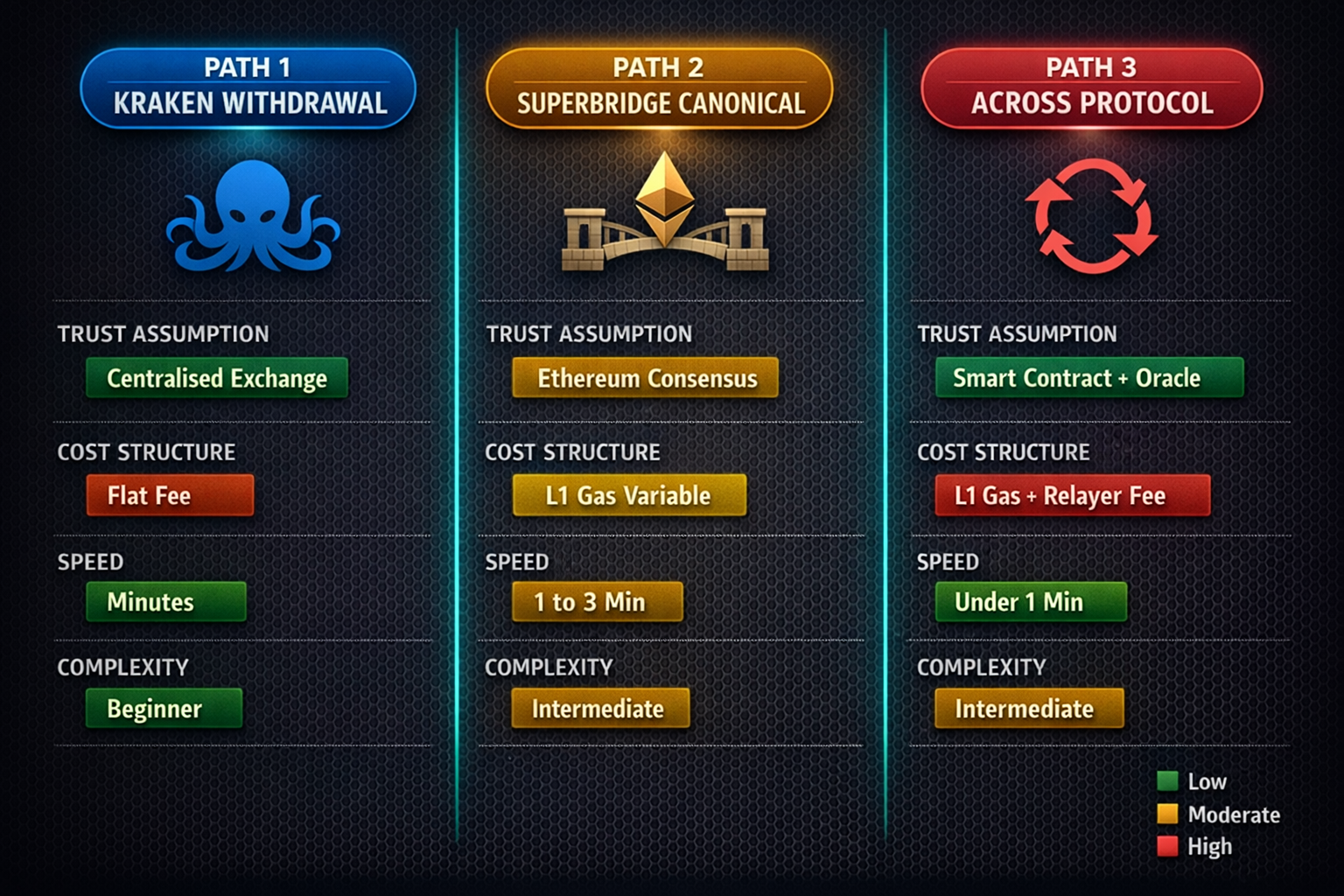
There are three distinct methods for getting funds onto Ink, each with different trust assumptions, costs, and speed.
Path 1 — Kraken direct withdrawal. If you already hold ETH or tokens on Kraken, you select Ink as your withdrawal network and send directly to your personal wallet. No bridge interface, no smart contract approval, no gas payment beyond Kraken's flat fee. This is the simplest route and the best starting point for beginners.
Path 2 — Superbridge canonical deposit. Superbridge is the official bridge interface for OP Stack chains. You connect your Ethereum wallet, send funds from Ethereum's main network (called mainnet) to Ink, and your deposit is secured by Ethereum's own consensus mechanism. Deposits usually take 1–3 minutes; occasionally up to 10 during extreme L1 congestion. This is the most trustless bridge mechanism — the deposit itself is verified by Ethereum's consensus rather than relying on a third-party intermediary. (Note: once on Ink, you still depend on the Ink sequencer to include your transactions on L2.)
Path 3 — Across Protocol fast bridge. Across Protocol is Ink's official day-one bridging partner. It uses a relayer model: a relayer on the destination chain immediately sends you funds (~2 seconds for L2-to-L2), then claims reimbursement through Across's settlement layer (disputes are arbitrated via UMA's Optimistic Oracle). Crucially, Across works from Ethereum mainnet or from other Layer 2 chains like Base, OP Mainnet, and Arbitrum. If your funds are already on one of those L2s, this route skips mainnet gas entirely. Important: Across only supports specific L2s as source chains for Ink — as of publication, these are Base, OP Mainnet, and Arbitrum. If your funds are on zkSync, Scroll, Linea, or another L2 not listed, you'll need to bridge to a supported chain first or use a different method.
The decision tree is straightforward:
- ›Funds on Kraken already? → Path 1
- ›Funds in a self-custody wallet on Ethereum mainnet? → Path 2 or Path 3
- ›Funds on a supported L2 (Base, OP Mainnet, Arbitrum)? → Path 3 (skip mainnet, save £5–15+ in gas)
- ›Bridging under £500? → Path 1 almost always wins on fees
- ›Need speed? → Path 3
Supported Tokens by Method
| Method | ETH | USDC | USDT | DAI | Other ERC-20s |
|---|---|---|---|---|---|
| Kraken withdrawal | ✅ | Check Kraken's asset page for Ink network support | Check Kraken's asset page | Check Kraken's asset page | Limited — check Kraken |
| Superbridge | ✅ | ✅ (canonical) | Check Superbridge UI | Check Superbridge UI | Limited to tokens with canonical Ink deployments |
| Across Protocol | ✅ | ✅ (may deliver bridged/wrapped version) | Check across.to | Check across.to | Limited — check across.to for current list |
Token support changes frequently. Always verify on the bridge interface before initiating a transaction.
Canonical vs. Wrapped Tokens — What You Need to Know
When you bridge a token like USDC via different methods, you may receive different versions of that token on Ink:
- ›Canonical tokens are the "official" version recognised natively by the Ink chain. When you bridge USDC via Superbridge, you receive the canonical Ink-native USDC.
- ›Wrapped or bridged tokens are representations created by a third-party bridge. When you bridge USDC via Across, you may receive a wrapped version (e.g., "USDC.e" or "Across-bridged USDC") that has a different contract address.
Why this matters: Some DeFi protocols on Ink only accept the canonical version. If you bridge via Across and receive a wrapped token, you may need to swap it for the canonical version on SuperSwap or Velodrome before you can use it in protocols like Tydro. Always check the token contract address against what the protocol you want to use accepts.
The comparison table above tells you which method to read first. If you're unsure where your funds are, start with Method 1.
03
What You Need Before You Start
Before touching any bridge, set up your destination.
1. Install a self-custody wallet. A self-custody wallet (sometimes called a non-custodial wallet) is software that holds your private keys — the cryptographic passwords that control your funds. MetaMask and Rabby are the two most common options. Rabby auto-detects new networks like Ink and switches between them automatically, making it friendlier for beginners. MetaMask has wider protocol compatibility but requires you to add Ink manually.
2. Add the Ink network to your wallet. Your wallet needs Ink's network details — a Chain ID (its unique identifier), an RPC endpoint (the server URL your wallet uses to communicate with the chain), and a block explorer address. Find the official values at docs.inkonchain.com. In Rabby, Ink may appear automatically. In MetaMask, navigate to Settings → Networks → Add Network and enter the details manually. Getting these wrong means transactions fail or go nowhere.
3. Ensure you have ETH for gas. Ink uses ETH (Ether) as its gas token — the small fee paid for every transaction. Ink's gas fees are fractions of a penny, but you still need some ETH in your wallet. Plan to bridge at least £5–10 worth of ETH as your first transaction, even if your main goal is to bridge USDC or another token.
4. If using the Kraken path: you need a verified Kraken account with funds already deposited. Verification typically takes minutes but can take longer during high-demand periods.
5. If using a bridge path: you need ETH or supported tokens in a self-custody wallet on Ethereum mainnet (for Superbridge or Across) or on a supported L2 (for Across only — currently Base, OP Mainnet, and Arbitrum).
If you don't currently hold ETH and prefer a no-KYC option for acquiring some before bridging, ChangeNOW allows you to swap other cryptocurrencies for ETH without account registration, which you can then send to your self-custody wallet and bridge to Ink.
For any bridge involving significant funds, signing with a hardware wallet like Ledger ensures your private keys never touch an internet-connected device — especially important when approving token contracts on bridge interfaces.
What this means for you: Spend ten minutes on setup now. A correctly configured wallet prevents every common bridging error described later in this article.
04
Staying Safe While Bridging
Bridge exploits have caused some of the largest losses in crypto history — Wormhole ($320M, 2022), Ronin ($625M, 2022), Nomad ($190M, 2022). While the methods recommended in this article use well-audited protocols, you must take precautions.
Verify You're on the Real Bridge URL
Phishing sites impersonate bridge interfaces to steal your funds. Before connecting your wallet:
- ›Superbridge: The official URL is superbridge.app. Bookmark it. Do not click bridge links from search engine ads, Discord DMs, or social media posts.
- ›Across Protocol: The official URL is across.to. Bookmark it.
- ›Kraken: Access only via kraken.com. Use your existing bookmark or type the URL manually.
Check for HTTPS and the exact domain spelling. Phishing sites often use subtle misspellings (e.g., "superbrige.app" or "acr0ss.to").
Smart Contract Approval Risks
When using Superbridge or Across to bridge ERC-20 tokens (not ETH), you'll be asked to approve the bridge's smart contract to spend your tokens. This is a standard Ethereum interaction, but:
- ›Approve only the exact amount you're bridging if your wallet gives you the option (Rabby does this by default). Unlimited approvals mean the contract can spend all of that token in your wallet — if the contract is ever exploited, your entire balance is at risk.
- ›Revoke old approvals after bridging using tools like revoke.cash.
General Security Checklist
- ›Never share your seed phrase or private keys with anyone or any website.
- ›Use a hardware wallet for transactions above £1,000.
- ›Verify transaction details in your wallet's confirmation popup — check the destination address and amount before signing.
- ›If anything looks unfamiliar or unexpected during the bridge process, reject the transaction and start over.
What this means for you: Taking 30 seconds to verify URLs and approval amounts protects you from the most common attack vectors. Bookmark the official bridge URLs now.
05
Method 1: Withdraw from Kraken Directly to Ink
This is the path with the fewest moving parts. No bridge interface, no gas estimation, no smart contract approval.
Step-by-Step Instructions
1. Log in to your Kraken account at kraken.com. Ensure two-factor authentication (2FA) is enabled.
2. Navigate to Funding → Withdraw (on the Kraken Pro interface) or tap "Transfer" → "Withdraw" on the mobile app.
3. Select the asset you want to withdraw — start with ETH so you have gas on Ink.
4. Choose "Ink" as the withdrawal network. If Ink appears as an option for your selected asset, select it. The withdrawal fee shown will be Kraken's flat fee for that asset on the Ink network.
5. Paste your Ink wallet address. Copy this from your MetaMask or Rabby wallet — make sure your wallet is set to the Ink network when you copy the address. Double-check the first and last four characters after pasting.
6. Enter the amount you wish to withdraw.
7. Review the summary screen. Confirm the network says "Ink," the address is correct, and the fee is as expected.
8. Confirm the withdrawal. Kraken will send you an email and/or 2FA confirmation. Complete this step promptly — some confirmations expire after a few minutes.
9. Wait for processing. Kraken withdrawals to Ink typically arrive within a few minutes, though they can take up to 30 minutes during security reviews.
Fee consideration: Kraken's flat withdrawal fee means the cost is the same whether you send £50 or £5,000. For smaller amounts, this makes Kraken withdrawals proportionally cheaper than mainnet bridge transactions where gas alone might cost £5–15. For larger amounts (£2,000+), the flat fee becomes negligible relative to the total, and you might prefer the self-custody control of a bridge.
If It Doesn't Work
- ›Ink not appearing as a network option: Kraken rolls out network support progressively. Confirm Ink withdrawals are supported for your specific asset on Kraken's fee schedule page.
- ›Withdrawal pending for more than 30 minutes: Kraken occasionally delays withdrawals for security reviews. Check your email for any action-required notices. This is a Kraken-side delay, not an Ink network issue.
- ›Funds not visible in wallet: Ensure your wallet is connected to the Ink network (not Ethereum mainnet). If you're using MetaMask, manually switch to the Ink network via the dropdown in the top-left corner.
What this means for you: If you already use Kraken, this is your lowest-friction entry point to Ink. Bridge ETH first to secure your gas, then withdraw any additional tokens in a second transaction.
06
Method 2: Bridge from Ethereum via Superbridge
This is the canonical bridge — the "official" Ethereum-to-Ink deposit mechanism built into the OP Stack. The word canonical here means it's the bridge recognised by the chain itself, and the deposit mechanism inherits Ethereum's security guarantees. (Note: while the bridge transaction itself is verified by Ethereum's consensus, once your funds arrive on Ink you are trusting the Ink sequencer to process your L2 transactions correctly. Fault proofs provide a safety net if the sequencer misbehaves — see the Security section below.)
Step-by-Step Instructions
1. Go to superbridge.app — type the URL directly or use your bookmark. Verify the URL is exactly correct before connecting your wallet.
2. Connect your wallet. Click "Connect Wallet" and select MetaMask, Rabby, or your preferred wallet. Approve the connection request in your wallet popup.
3. Select "Ethereum" as the source chain and "Ink" as the destination chain. Superbridge may auto-detect if you're on Ethereum mainnet, but verify both fields.
4. Choose the token you want to bridge (e.g., ETH or USDC) and enter the amount. The interface will show you the estimated gas cost for the L1 transaction.
5. If bridging an ERC-20 token (e.g., USDC): you'll first need to approve the token. A separate transaction will appear in your wallet — this grants the bridge contract permission to move your tokens. Approve only the exact amount if your wallet offers this option.
6. Confirm the bridge transaction. Review the details in your wallet popup: destination chain (Ink), amount, and gas fee. If the gas fee seems unusually high, cancel and try again during a lower-congestion period (see timing tips in the Costs section).
7. Wait for confirmation. The Ethereum transaction typically confirms within 1–3 minutes. Occasionally up to 10 minutes during extreme L1 congestion.
8. Switch your wallet to the Ink network and check your balance. Your bridged funds should appear shortly after the Ethereum transaction confirms.
The critical asymmetry most guides bury: deposits (Ethereum → Ink) are fast, usually 1–3 minutes. Withdrawals (Ink → Ethereum) take seven days. This is a fundamental property of Optimistic Rollups — the type of Layer 2 architecture Ink uses. The seven-day window exists so that anyone can challenge a fraudulent state submission. This challenge period applies to canonical withdrawals from Ink to Ethereum mainnet. If you want faster exits, see Method 3's reverse route using Across in the "Bridge Back" section below.
Gas timing matters. The Ethereum mainnet gas fee you pay for this bridge transaction fluctuates wildly — a bridge that costs £12 on a Tuesday evening might cost £3 at 4am UTC on a Sunday. Check a gas tracker before confirming. This is the single biggest cost variable for Method 2.
If It Doesn't Work
- ›Transaction stuck as pending: Ethereum mainnet congestion can delay confirmation. Wait for the transaction to either confirm or fail — do not submit a second bridge transaction unless the first has explicitly failed.
- ›Funds not appearing on Ink after 15 minutes: Canonical deposits occasionally take longer during periods of heavy L1 activity. Check the transaction hash on Etherscan to confirm it was successful on Ethereum's side, then check Ink's block explorer.
- ›Bridged token not visible in wallet: If you bridged an ERC-20 token (any token following Ethereum's standard token format, like USDC), you may need to manually add the token's Ink contract address to your wallet. Find the correct address in Ink's documentation or block explorer — do not trust addresses from unofficial sources.
What this means for you: Superbridge provides the strongest bridge-level security guarantees, but it costs Ethereum mainnet gas and only works from Ethereum mainnet. If your funds are already on another L2, skip this method and use Across instead.
07
Method 3: Bridge via Across Protocol (Fast Route)
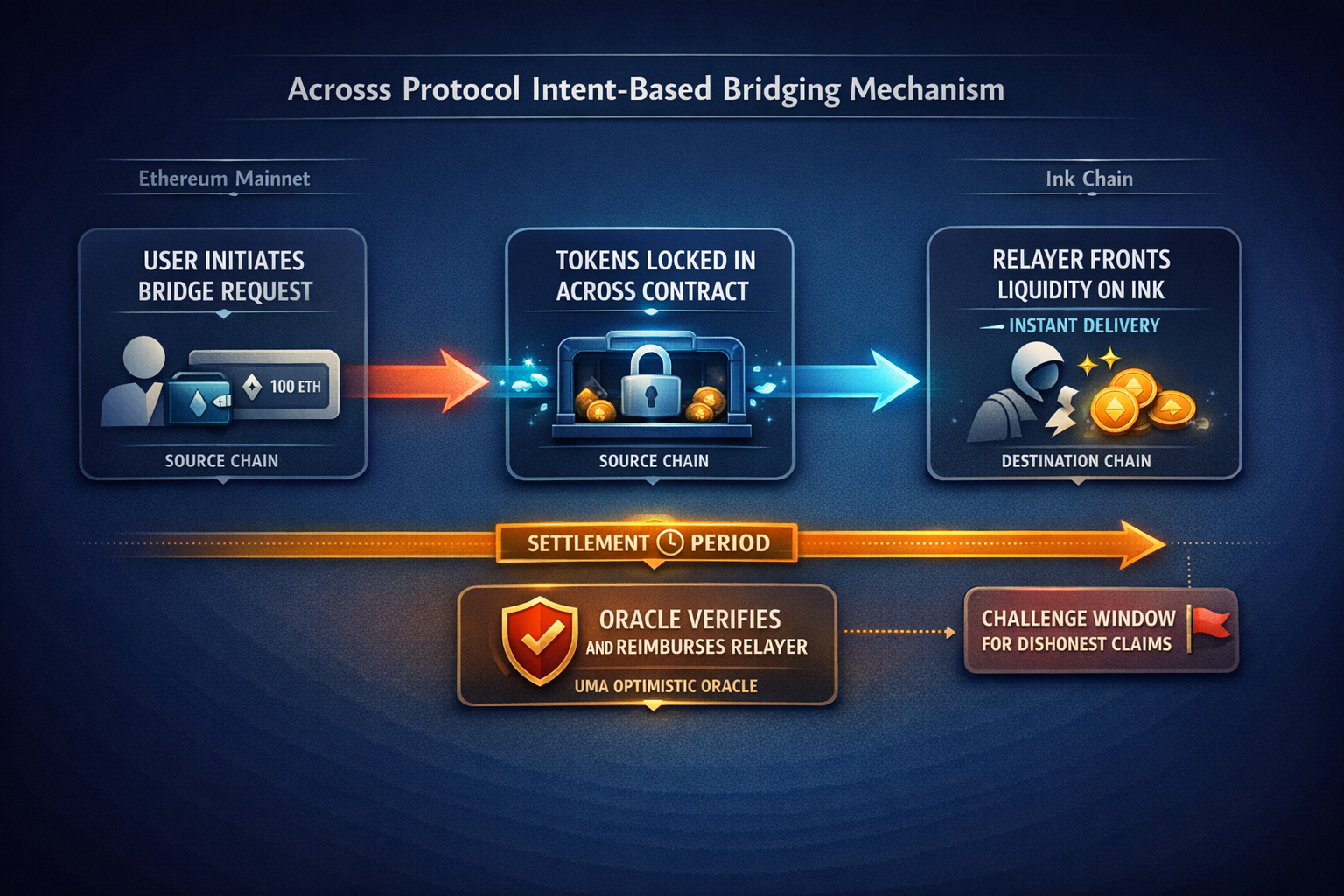
Across Protocol was Ink's official bridging partner from day one. It uses an intent-based architecture: when you request a bridge, a relayer on the destination chain immediately sends you the funds, then the relayer gets reimbursed through Across's settlement layer. Disputes are arbitrated via UMA's Optimistic Oracle — a system where challenges can be raised if a relayer acts dishonestly.
A note on custody: While your funds are not held by a centralised intermediary, your source-chain tokens ARE locked in Across's smart contract until settlement completes. You are trusting Across's contract logic and UMA's oracle to function correctly. This is a different (and more limited) trust assumption than a centralised custodian, but it is not zero counterparty risk. For small-to-medium amounts, Across has a well-tested track record.
Step-by-Step Instructions
1. Go to across.to — type the URL directly or use your bookmark. Verify the URL is exactly correct before connecting your wallet.
2. Connect your wallet. Click "Connect Wallet" and select your wallet provider. Approve the connection request.
3. Select your source chain. Choose where your funds currently are: Ethereum mainnet, Base, OP Mainnet, or Arbitrum. These are the currently supported source chains for bridging to Ink.
4. Select "Ink" as the destination chain.
5. Choose the token you want to bridge (e.g., ETH, USDC) and enter the amount. The interface will display the estimated relayer fee, gas cost, and expected arrival time.
6. Review the fee breakdown and estimated delivery time. Across's relayer fee is dynamic — typically 0.04–0.12% depending on route, token, and current liquidity utilisation. Larger ETH transfers on popular routes tend toward the lower end; smaller amounts or less liquid tokens may be higher. The estimated time for L2-to-L2 transfers is typically 2–10 seconds.
7. If bridging an ERC-20 token: approve the token spend first (same process as Superbridge — approve only the exact amount if possible).
8. Confirm the bridge transaction in your wallet. Review the details: source chain, destination (Ink), amount, and total fees.
9. Verify arrival. Switch your wallet to Ink and check your balance. You can also track your transaction on Across's status page using your source-chain transaction hash.
The L2-to-L2 shortcut most guides miss entirely: if your funds are already sitting on Base, OP Mainnet, or Arbitrum, using Across to bridge directly to Ink skips Ethereum mainnet gas completely. You pay only the source-chain L2 gas (fractions of a penny) plus Across's relayer fee. Withdrawing from an L2 to Ethereum mainnet and then bridging to Ink via Superbridge would cost you mainnet gas twice — once to withdraw, once to deposit. The L2-to-L2 route through Across saves £10–30 or more.
If It Doesn't Work
- ›Bridge transaction confirmed but funds not on Ink: Across relayer delays are rare but possible during extreme congestion. Check Across's transaction status page at across.to using your source-chain transaction hash.
- ›Received a different token version than expected: When bridging tokens like USDC, Across may deliver a wrapped representation rather than the canonical Ink-native version (see the "Canonical vs. Wrapped Tokens" explanation above). Verify the token contract address against what protocols like Tydro and Velodrome accept. If it differs, swap the wrapped version for the canonical version on SuperSwap or Velodrome.
What this means for you: Across is the fastest route and the only option that works from other supported L2s. If speed matters or you're starting from Base, OP Mainnet, or Arbitrum, this is your method.
08
Verifying Your Bridge Transaction Arrived
Regardless of which method you used, verification follows the same steps:
1. Open Ink's block explorer. Find the link in Ink's official documentation at docs.inkonchain.com. Paste your wallet address into the search bar.
2. Check your ETH balance. It should reflect the amount you bridged minus any fees. If it shows zero, confirm your wallet is on the Ink network — not Ethereum mainnet or another L2.
3. Check for ERC-20 tokens. Bridged tokens like USDC may not display automatically. Look for a "Token Holdings" or "ERC-20 Tokens" tab in the block explorer. If the token appears there but not in your wallet app, add the token contract address manually to MetaMask or Rabby.
4. Confirm you have gas. Attempt a trivially small transaction — even viewing a contract interaction estimate — to confirm your wallet can sign and submit transactions on Ink.
If funds haven't appeared within the expected timeframe (minutes for Kraken and Across, up to 10 minutes for Superbridge during congestion), do not re-bridge. Wait, check the source-chain transaction first, and then check Ink's block explorer again.
What this means for you: Verification takes 60 seconds and prevents every downstream problem. Do it before moving on.
⚠
Always bridge ETH first
If you bridge only USDC or another ERC-20 token, you arrive on Ink with zero gas and cannot execute any transaction — not even a swap to get ETH. Bridge at least £5–10 in ETH before or alongside any token transfer.
09
Bridging Costs Breakdown and How to Minimise Fees
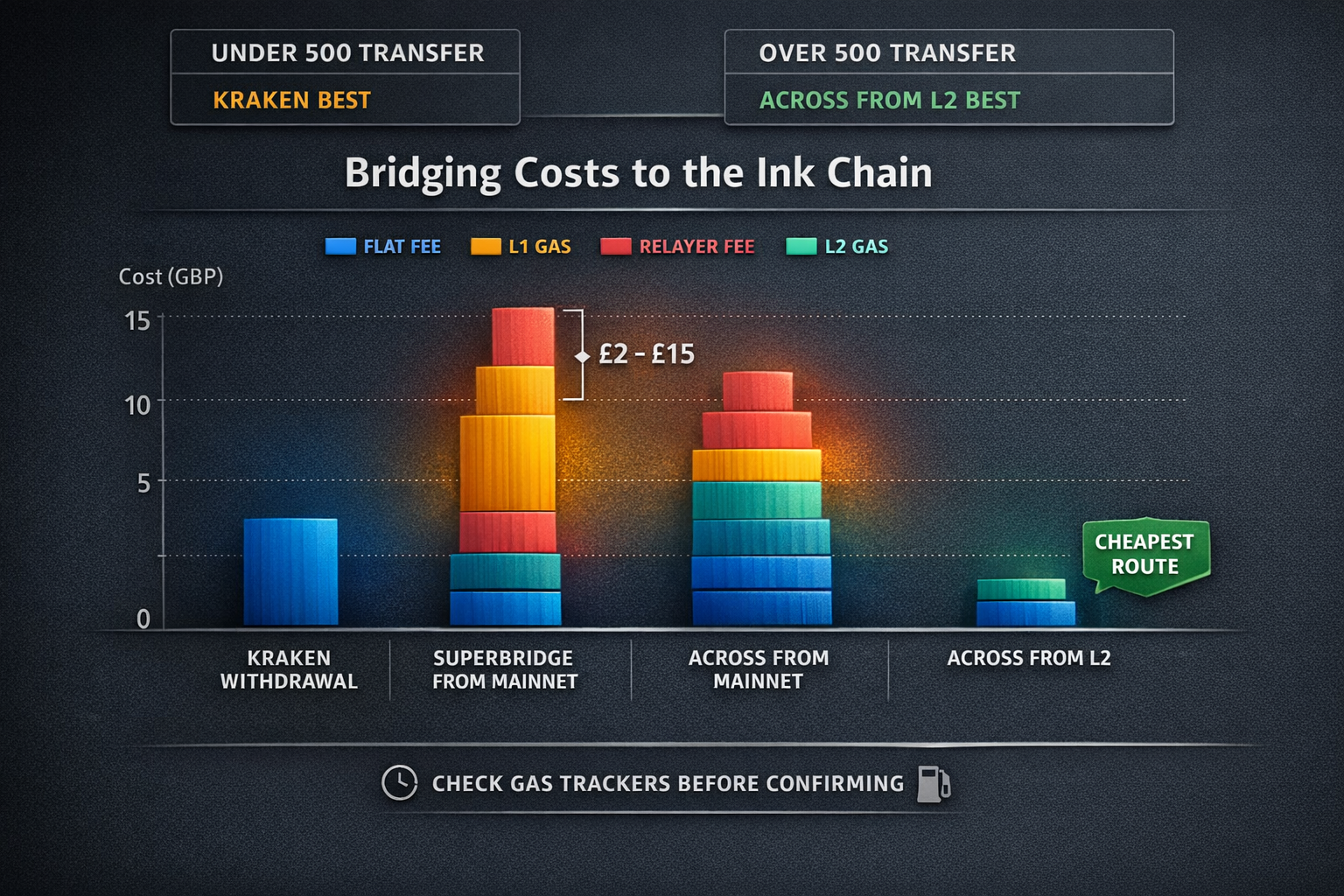
The largest cost variable is Ethereum mainnet gas — and most people overpay because they bridge at peak times.
- ›Kraken withdrawal: Flat fee per asset per network. Best for amounts under ~£500 where the flat fee is proportionally smaller than mainnet gas.
- ›Superbridge from Ethereum mainnet: You pay L1 gas, which ranges from ~£2 to £15+ depending on network congestion. Check a gas tracker before confirming.
- ›Across from Ethereum mainnet: You pay L1 gas plus a dynamic relayer fee (typically 0.04–0.12% depending on route, token, and liquidity utilisation — check across.to for a live estimate before confirming).
- ›Across from another L2: You pay only L2 gas (fractions of a penny) plus the relayer fee. This is almost always the cheapest bridge route if your funds are already on Base, OP Mainnet, or Arbitrum.
Timing strategies that work:
- ›Bridge during low-activity windows: weekends, early UTC mornings (before US markets open) typically have the lowest mainnet gas.
- ›Monitor a gas tracker for 24 hours before bridging — you'll see 3–5x swings within a single day.
- ›For amounts under £100, Kraken direct withdrawal eliminates gas uncertainty entirely.
UK Tax Note
Each bridge transaction may have UK tax implications. HMRC treats crypto-to-crypto disposals as potentially subject to Capital Gains Tax. Key points for bridging:
- ›Bridging ETH to ETH (same token, same representation on the destination chain) is generally not treated as a disposal — you're moving the same asset between networks.
- ›Receiving a wrapped or different token version (e.g., bridging USDC and receiving a bridged USDC variant) could be interpreted as a disposal/acquisition depending on how HMRC classifies the tokens. This is a grey area — keep records of every bridge transaction.
- ›Swapping wrapped tokens for canonical tokens on a DEX IS a disposal and may trigger Capital Gains Tax if the value has changed since you acquired the original token.
Tools like Koinly can automatically track cross-chain bridge transactions, and you can estimate your potential liability with our free CGT calculator. Consider consulting a tax professional if you're bridging significant amounts.
What this means for you: Choosing your bridge method and timing your transaction can turn a £15 cost into a £2 cost. For anyone bridging under £500, Kraken direct withdrawal is the default answer. Keep records of every bridge transaction for tax purposes.
10
Your First Five Transactions on Ink
Bridging gets your funds onto Ink. These five transactions activate your wallet across different protocol categories — which matters if you're positioning for the potential airdrop. Important caveat: the specific airdrop criteria are unknown. These recommendations are based on community analysis of what has historically qualified wallets for airdrops on similar chains — there is no guarantee these specific actions will qualify you for the INK airdrop.
1. Swap a small amount on SuperSwap or Velodrome.
- SuperSwap: Go to the SuperSwap interface (find the current URL via Ink's ecosystem page at inkonchain.com). Connect wallet → select ETH → USDC (or vice versa) → enter a small amount (even £5) → confirm swap.
- Velodrome: Go to velodrome.finance. Connect wallet → ensure you're on the Ink network → swap tab → select tokens and amount → confirm.
- Status: Both are live as of publication. This confirms your wallet works and registers you as a user of Ink's DEX (decentralised exchange) infrastructure. Velodrome is Ink's primary liquidity marketplace.
2. Register a .ink domain via ZNS.
- Go to the ZNS app (find the URL via Ink's ecosystem page). Connect wallet → search for your desired .ink name → register → confirm the transaction.
- Status: Live as of publication. This is cheap (typically under £1), creates a permanent on-chain identity, and touches a distinct protocol category.
3. Send a GM via OnChainGM.
- Go to the OnChainGM interface (find via Ink's ecosystem page). Connect wallet → click to send a GM or deploy a message → confirm. This deploys a simple smart contract or sends an on-chain message with one click, no coding required.
- Status: Live as of publication. This counts as developer-adjacent activity (contract deployment) for fractions of a penny.
4. Supply assets to Tydro.
- Go to tydro.com (verify URL via Ink's ecosystem page). Connect wallet → select the asset you want to supply (e.g., ETH or USDC) → enter amount → approve token if needed → confirm deposit.
- Status: Live as of publication. Tydro is a lending protocol on Ink built on Aave V3 contracts — you deposit assets and earn yield while the protocol lends them to borrowers. (Note: verify whether Tydro holds a formal Aave licence or is an independent fork of Aave V3 contracts — the distinction affects governance and security audit coverage.) Community analysis suggests lending protocol usage is likely a high-weight airdrop qualification factor. If you're supplying ETH or stablecoins, use our staking calculator to model projected returns across different amounts and timeframes.
5. Mint an Ink Pass NFT via Sweep.
- Go to the Sweep minting page (find via Ink's ecosystem page or official Ink social channels). Connect wallet → select the Ink Pass NFT → mint → confirm.
- Status: Verify current availability on Ink's official channels before attempting — NFT mints may be time-limited or sold out. Sweep is the minting platform for Ink's Ink Pass NFT (non-fungible token — a unique digital item recorded on the blockchain). Holding ecosystem NFTs signals community participation.
Why this order matters: Transaction 1 confirms your wallet works. Transactions 2 and 3 are low-cost, low-risk identity and diversity signals. Transaction 4 is where meaningful protocol engagement begins. Transaction 5 is optional but covers the NFT category.
What this means for you: Five transactions, five distinct protocol categories, total cost well under £5 in gas. After this, your wallet has demonstrated genuine multi-protocol usage rather than a single bridge-and-idle pattern. But remember: these are educated guesses about what might matter, not confirmed criteria.
11
Ink vs. Base: Why Timing Matters
Base is the closest comparison to Ink — both are OP Stack Layer 2 chains backed by major centralised exchanges. Base has a 20-month head start, Coinbase's 110M user base, and significant TVL (total value locked — the sum of all assets deposited across the chain's protocols; check DeFiLlama for the current figure, which fluctuates significantly). By every maturity metric, Base is further along.
But there's one distinction that reshapes the entire calculus for strategic participants: Ink has a confirmed airdrop. Base does not.
Base has never announced a token or airdrop. Users who've been active on Base for 20 months have no guarantee of any token reward. The Ink team has explicitly confirmed the INK token and airdrop in their official blog communications. No TGE date has been announced; community speculation ranges from late 2025 to mid-2026, but nothing is confirmed.
Additional technical characteristics of Ink:
- ›1-second block times vs. Base's current 2-second target — though Base has publicly committed to moving to sub-second block times as part of Optimism's planned upgrades, so this gap is expected to narrow.
- ›Multiple fault proof challengers (Kraken + Gelato) — Ink activated permissioned fault proofs with multiple independent challengers in early 2025, meaning multiple independent parties can challenge fraudulent state submissions. Most Superchain chains at that time relied on a single challenger. (Note: OP Mainnet itself activated fault proofs in June 2024 before Ink launched. Ink's distinction was being among the first non-OP-Mainnet Superchain chains to go live with multi-party fault proof challengers.)
What this means for you: Ink's confirmed airdrop at an early stage represents the core thesis for bridging now rather than waiting. But confirmed does not mean guaranteed for your specific wallet. Sybil filtering and undisclosed allocation formulas mean activity quality matters more than quantity.
12
Security Considerations for Bridged Funds
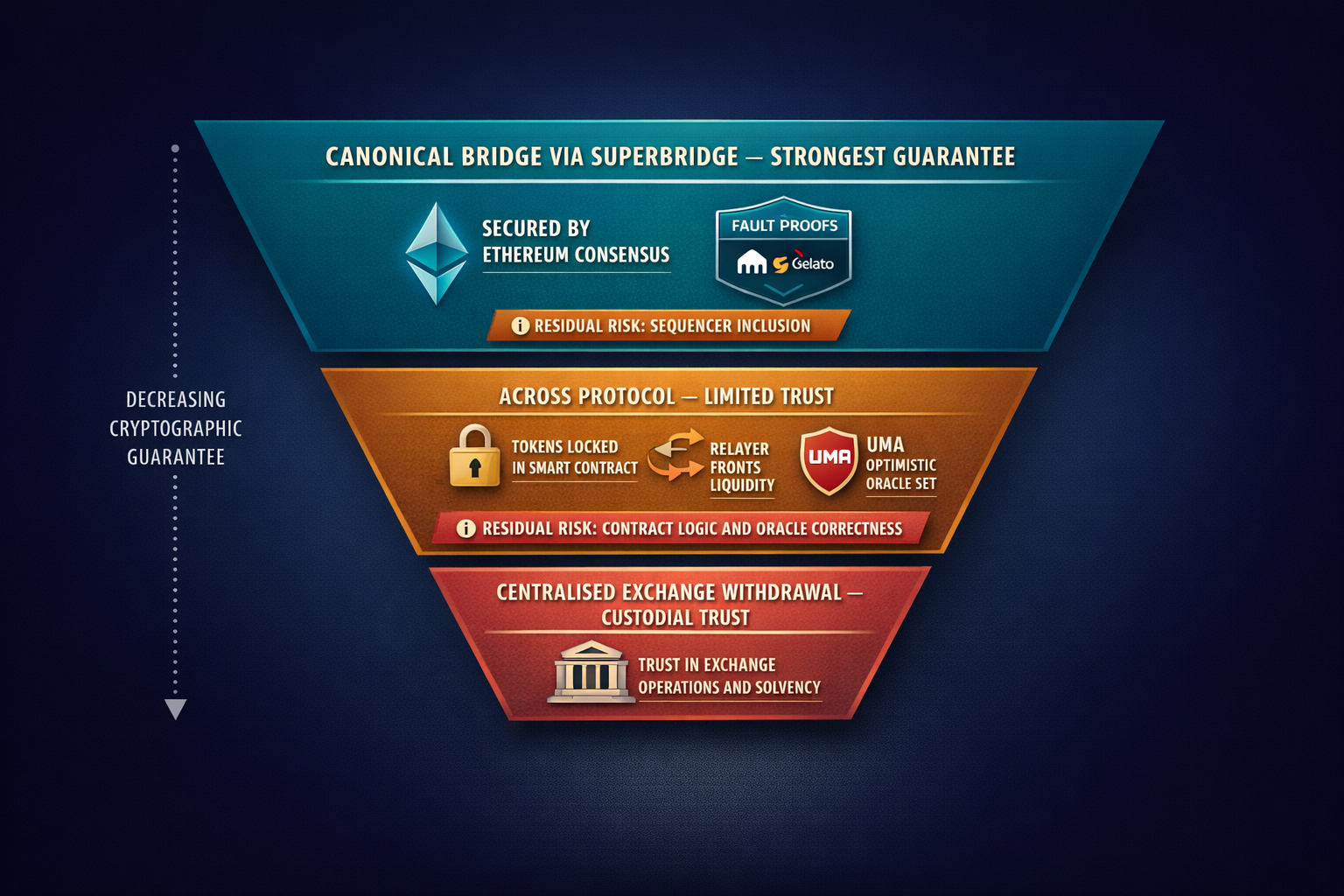
Each bridge method carries different trust assumptions. Understanding them lets you match your security posture to your risk tolerance.
- ›Canonical bridge (Superbridge): Your deposit transaction is secured by Ethereum's consensus mechanism. Once on Ink, the chain's fault proofs — with Kraken and Gelato as multiple independent challengers — mean that if anyone submits a fraudulent state claim, it can be disputed and overturned. This provides the strongest bridge-level security. However, you are still trusting the Ink sequencer to correctly include your L2 transactions — the fault proof mechanism is the safety net if it doesn't.
- ›Across Protocol: Your source-chain tokens are locked in Across's smart contract until settlement completes. A relayer fronts you liquidity immediately on the destination chain, then claims reimbursement via UMA's Optimistic Oracle. If the oracle system fails, the relayer (not you) bears the loss — but you are trusting Across's contract logic to function correctly. For small-to-medium amounts, this is a well-tested model with a strong audit history.
- ›Kraken withdrawal: You trust Kraken as a centralised custodian during the transfer. Kraken is a regulated exchange with a UK limited registration, but centralised custody is a fundamentally different trust model than on-chain verification.
What this means for you: For most people bridging under £5,000, any of the three methods is appropriate. For larger amounts, the canonical bridge via Superbridge provides the strongest security guarantees at the bridge layer.
13
How to Bridge Back from Ink
A bridge guide that only covers one direction is incomplete. Here's how to exit Ink when you're ready.
Route 1: Canonical Withdrawal (Ink → Ethereum Mainnet)
1. Go to superbridge.app and connect your wallet.
2. Select Ink as the source and Ethereum as the destination.
3. Choose the token and amount you want to withdraw.
4. Confirm the transaction on Ink (costs fractions of a penny in L2 gas).
5. Wait seven days. This is the standard Optimistic Rollup challenge period — non-negotiable. During this time, anyone can dispute a fraudulent state submission. Your funds are locked until the challenge period expires.
6. After seven days, return to Superbridge and finalise the withdrawal. This requires an Ethereum mainnet transaction (you'll pay L1 gas).
7. Your funds arrive in your Ethereum mainnet wallet.
Important: This seven-day delay applies to ALL canonical withdrawals from Ink to Ethereum mainnet, regardless of the token. There is no way to speed up a canonical withdrawal once initiated.
Route 2: Fast Exit via Across (Ink → Ethereum, Base, OP Mainnet, or Arbitrum)
1. Go to across.to and connect your wallet.
2. Select Ink as the source chain and your desired destination.
3. Choose token and amount.
4. Review the fee — Across charges a liquidity premium for providing immediate funds while it waits out the challenge period on your behalf. This fee is higher than the inbound bridging fee.
5. Confirm the transaction. Funds arrive in seconds to minutes.
Route 3: Deposit Back to Kraken
1. Log in to Kraken and navigate to Funding → Deposit.
2. Select the asset and choose Ink as the deposit network (if supported — verify on Kraken's deposit page).
3. Copy your Kraken Ink deposit address.
4. In your wallet on the Ink network, send the asset to the Kraken deposit address.
5. Wait for Kraken to credit your account (typically minutes, but processing times vary).
A note on L2-to-L2 withdrawals: If you want to move funds from Ink to another L2 (e.g., Base), using Across is the practical option. The canonical bridge only goes to Ethereum mainnet. There is no way to canonically bridge directly from Ink to another L2 without going through Ethereum mainnet first (which would incur the 7-day delay plus two L1 gas payments).
What this means for you: If you might need funds back on Ethereum urgently, either keep reserves on mainnet or budget for Across's fast-exit fee. Do not bridge your entire portfolio to Ink expecting instant retrieval.
14
Complete Airdrop Action Checklist After Bridging
Bridging is the registration step. Everything above it on the airdrop-qualifying spectrum involves sustained protocol usage. Reminder: the specific airdrop criteria have not been disclosed. The following tiers are based on community analysis and historical patterns from other L2 airdrops — not confirmed information.
Budget Tiers
Minimum (~£100 total): Bridge £50–100 in ETH. Execute 1–2 swaps. Register a .ink domain. Send GMs via OnChainGM. Join Discord. This establishes your wallet as a real participant with minimal capital.
Medium (~£1,000–2,000): Supply £500–2,000 to Tydro. Execute trades on Nado (a perpetual futures DEX on Ink — the team has explicitly confirmed INK allocation for traders). Mint the Ink Pass NFT. Deploy a contract via OnChainGM. This puts you in the active user tier across multiple protocol categories.
Maximum (£5,000–10,000+): High Tydro supply maintained over months. High-volume Nado trading. Active liquidity provision on Velodrome. Developer contributions. This maximises touchpoints but requires significantly more capital and engagement.
Quality Over Quantity
Airdrop sybil detection systems look for red flags: bridging exactly round numbers, bridging and immediately bridging back, identical activity patterns across multiple wallets on the same day. A genuine user bridges an irregular amount, leaves funds deployed in protocols, and interacts across weeks. The bridge transaction itself is a data point — make it reflect organic intent, not automated farming.
What this means for you: One clean wallet, diverse protocol interactions, sustained activity over time. That combination outperforms any clever multi-wallet strategy that sybil filters are specifically designed to catch.
Post-Bridge Airdrop Qualification Checklist
✓
Bridge ETH to Ink via any method (this article's core task)✓
Execute at least one swap on SuperSwap or Velodrome✓
Supply assets to Tydro Season 2 and maintain position over weeks✓
Execute trades on Nado perpetual DEX (INK allocation confirmed for traders)✓
Register a .ink domain via ZNS✓
Deploy a contract or send a GM via OnChainGM✓
Mint Ink Pass NFT via Sweep if available15
Quick Recap
- ›Choose your bridge method by source: Kraken account → direct withdrawal; Ethereum wallet → Superbridge or Across; supported L2 (Base, OP Mainnet, Arbitrum) → Across (skip mainnet gas entirely)
- ›Bridge ETH first — arriving with only ERC-20 tokens and zero gas strands your funds
- ›Deposits to Ink take minutes; canonical withdrawals back to Ethereum take seven days — use Across for faster exits, or plan accordingly
- ›Bridging is the prerequisite, not the strategy — Tydro lending and Nado trading are where sustained protocol engagement happens
- ›One clean wallet with genuine multi-protocol usage beats every multi-wallet farming scheme
- ›Verify bridge URLs before connecting your wallet — bookmark superbridge.app and across.to
- ›Keep records of every bridge transaction for UK tax purposes